Cheese, Pears, and History in a Proverb by Brombert Beth A. Montanari Massimo
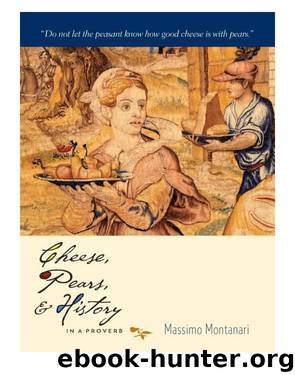
Author:Brombert, Beth A., Montanari, Massimo [Brombert, Beth A., Montanari, Massimo]
Language: eng
Format: epub
Publisher: Columbia University Press
Published: 2011-06-06T17:00:00+00:00
Things got complicated, however, when the idea of instinctive taste—which opens the way to knowledge of the world and its rules—was superseded by another idea, that of good taste, meaning a cultivated knowledge filtered by the intellect.
This is not a new idea. It can also be found in medieval culture where it cohabited with instinctive knowledge (the two notions will always live side by side). It happened that, up to a point—between the sixteenth and seventeenth centuries, first in Italy and Spain, then in France and other countries—this idea of cultivated taste asserted itself and from a minority view became the dominant one in figurative usages as well. The ability to (learn how to) appreciate is not only applicable to the choice of foods—in the specific meaning of the sense of taste—but, metaphorically, to anything that makes daily life “beautiful” by filling the senses—sight, hearing, touch, smell, taste—with sensations that only an exacting, trained intellect is capable of enjoying.
According to Luca Vercelloni, all this was encouraged by the passing of the term “taste” into metaphor, no longer to indicate taste in its alimentary meaning (subjective and instinctive), but rather in its esthetic meaning—metaphor that only recently succeeded in “retroactively redefining the primitive meaning of the term, assigning a cultural quality even to taste in the palatal sense.” My impression is that the notion of good taste involves, from the outset, the ability to choose food, and perhaps for that reason it was not the figurative use that gave rise to the idea of good taste but, on the contrary, the early development of this idea in the domain of gastronomy that encouraged its extension into other areas. This is the hypothesis advanced, with extreme caution, by Jean-Louis Flandrin. While admitting the possibility that “metaphoric use may have fostered . . . the appearance of good taste in things alimentary,” he asks, “how could such a metaphor [that of intellectual taste] have been created and cultivated . . . by a society that was indifferent to culinary finesse and sensitive perceptions in the domain of food?” In the final analysis, it is hard to know “if the idea of good taste—or of its opposite, bad taste—first appeared in the realm of food or in the world of arts and letters.” It is the first hypothesis that he finds more appealing.
One important detail: by itself, the notion of good taste in no way excludes instinct. A spontaneous, intuitive dimension is attributed even to intellectual judgment (Voltaire defined taste, in the sense of good taste, as a kind of “immediate discernment, such as that of the tongue and the palate”). But the idea of good taste that finally established itself is of a mediated knowledge, a “culturally remodeled” taste that, Vercelloni writes, matures over “a long cultural apprenticeship.”
And so, it was no longer true that “what pleases is good,” but “what is good is what pleases (or what one learns to like),” in other words, “good” is what is conventionally so considered by connoisseurs.
Download
This site does not store any files on its server. We only index and link to content provided by other sites. Please contact the content providers to delete copyright contents if any and email us, we'll remove relevant links or contents immediately.
Whiskies (Collins Gem) by dominic roskrow(45527)
101 Whiskies to Try Before You Die by Ian Buxton(45319)
World's Best Whiskies by Dominic Roskrow(45122)
Whiskies Galore by Ian Buxton(42156)
The Fast Metabolism Diet Cookbook by Haylie Pomroy(21256)
Chic & Unique Celebration Cakes by Zoe Clark(20149)
Craft Beer for the Homebrewer by Michael Agnew(18343)
The Bone Broth Miracle: How an Ancient Remedy Can Improve Health, Fight Aging, and Boost Beauty by Ariane Resnick(16705)
For the Love of Europe by Rick Steves(14907)
Tools of Titans by Timothy Ferriss(8593)
Chowders and Soups by Liz Feltham(8440)
A Court of Wings and Ruin by Sarah J. Maas(8110)
How to Be a Bawse: A Guide to Conquering Life by Lilly Singh(7613)
The Institute by Stephen King(7151)
Cravings: Recipes for All the Food You Want to Eat by Chrissy Teigen & Adeena Sussman(6862)
Wiseguy by Nicholas Pileggi(5933)
The Last Wish (The Witcher Book 1) by Andrzej Sapkowski(5592)
Spare by Prince Harry The Duke of Sussex(5368)
Room 212 by Kate Stewart(5271)
